
Loading…
Loading…

Sell-side consensus EPS, revenue estimates, YoY growth, forward P/E, and per-year analyst coverage, for any covered stock.
TapClick below to see what's inside, then upgrade to unlock for this and 80,000+ other tickers.
A year-by-year projected price path from the sell-side EPS consensus, with an editable target P/E and the implied annual return from today's price.
TapClick below to see what's inside, then upgrade to unlock for INTC and 80,000+ other tickers.
See price against where its own fundamentals say it should trade. The shaded gap is the discount or premium, across five valuation lenses.
TapClick below to see what's inside, then upgrade to unlock for INTC and 80,000+ other tickers.
See exactly how INTC's revenue becomes profit: a Sankey that traces revenue (and its reported segments) through gross profit, operating expenses, and net profit, with the year-over-year change on every line.
The same diagram the Chart Builder draws, right on the Summary tab. Upgrade to unlock it for INTC and 80,000+ other tickers.
Intel Corporation designs, develops, manufactures, markets, sells, and services computing and related end products and services in the United States, Ireland, Israel, and internationally. It operates through three segments: CCG, DCAI, and Intel Foundry. The company offers client computing group products, including client and commercial CPUs, discrete client GPUs, edge computing, and connectivity products; data center and AI products, such as server CPUs, discrete GPUs, and networking products; and semiconductors comprising wafer fabrication, substrates, and other related products and…
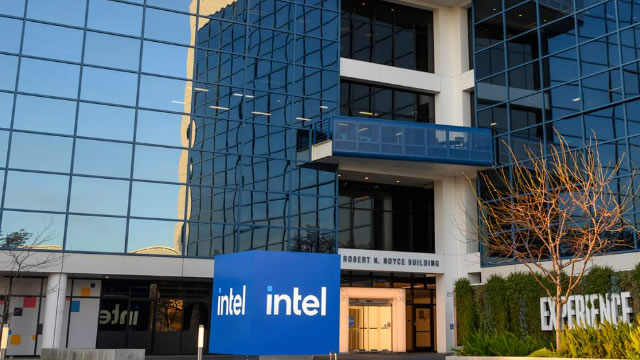
Intel stock soared 24% the day after its April report, its best day since 1987. Intel's third-quarter outlook called for adjusted earnings per share of $0.38, down from $0.42 in the second quarter.
AMD and Intel stocks rose on Friday, rebounding after a sector-wide sell-off a day earlier as investors returned to select technology shares despite weakness across the broader market. Advanced Micro Devices (AMD) gained 2%, while Intel was up 1.76%.

As new U.S. chip fabs get funded, the toolmakers and the chipmakers won't be paid at the same time. Here's where six chip stocks sit in that line.

Intel Corp. (INTC, Financials), the chip maker, has secured a one-year exemption from the Federal Communications Commission to continue to use some foreign-buil

Microsoft stock is an anomaly in the beaten-up AI sector as the large-cap hyperscaler holds near highs ahead of its fiscal Q4 report.