
Loading…
Loading…



In a previous article, we highlighted the benefits of getting international bond exposure in the context of using passive funds to achieve this level of fixed income diversification. Here, active strategies will be discussed in their application to the international bond market, which could be beneficial for further risk mitigation.

The Franklin International Aggregate Bond ETF has a poor historical total return profile, with a negative 1.71% return since inception. The fund's hedged nature and exposure to low-yielding government bonds from various jurisdictions contribute to its underwhelming performance. Going forward, investors should expect a maximum 3% annual return, making the fund unattractive compared to US treasuries yielding 5%.

Imagine stocks or funds that pay out their dividends once-a-month! Unlike waiting for quarterly, semi-annual or (ugh) annual payouts, your angst waiting for money is reduced by 300%, or more! These May U.S. exchange-traded monthly-paid (MoPay) dividends, upsides, and net gains include: 1. Stocks by yield (83); 2. Stocks by price upside (30); 3. Closed-End Investments, Exchange-Traded Funds & Notes (CEICs/ETFs/ETNs) by yield >9.56% (80).

The Franklin International Aggregate Bond ETF invests based on the Bloomberg Global Aggregate ex-USD Index Hedged USD. The Vanguard Total International Bond ETF invests based on the Bloomberg Barclays Global Aggregate ex-USD Float Adjusted RIC Capped Index (USD Hedged).
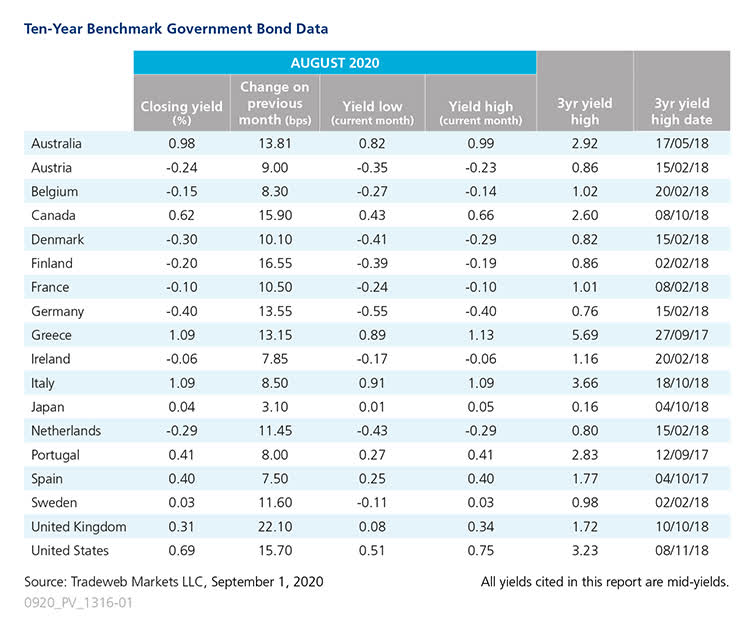
After months of plummeting yields, 10-year government bonds experienced a sell-off in August. The yield on Finland's 10-year benchmark note saw the largest increase of 16.5 basis points, ending the month at -0.20%.
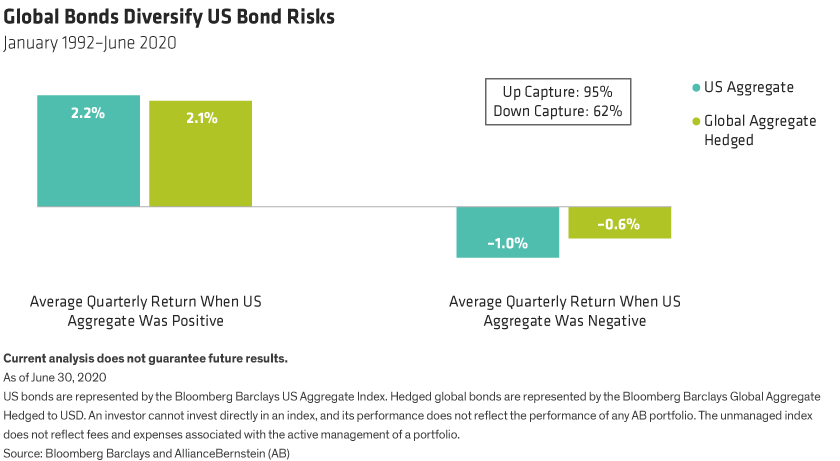
The global bond market is less volatile and supplies bigger diversification benefits than the US bond market.

60% of all global yields are now less than 1.00% and 86% of all global yields are now less than 2.00% according to the Financial Times.

The enormous increase in public spending during the coronavirus crisis and the fall in output will lead to a global government debt figure close to 105 percent of GDP.