
Loading…
Loading…


CLOD seeks to track an index providing exposure to companies in cloud computing across developed markets. The index starts from a universe of small-, mid-, and large-cap companies that may be classified within defined sub-industries of the cloud computing industry. Security selection is based on the free float market capitalization of all eligible securities with firms ranking at the top of each sub-industry chosen. Twenty companies from internet infrastructure software and data support software, 10 each from digital security software, data infrastructure software, and data architecture…
Is CLOD's expense ratio expensive, average, or a steal for its category?
Pro reveals the verdict on a 5-tier spectrum calibrated against ICI 2025 industry averages, with strategy-aware bands so the comparison is meaningful.

Enterprise digital transformation remains the primary driver of demand for public and hybrid cloud services.

Cloud computing ETFs have had a rough start to 2026, and Themes Cloud Computing ETF (NYSEARCA:CLOD) is no exception. The fund is down nearly 19% year-to-date through the end of February, with more than 15% of that loss coming in February alone. That kind of drawdown raises a fair question: is the sector-wide pressure a... Forget Individual Cloud Stocks: A Single ETF Captures the Entire Boom.
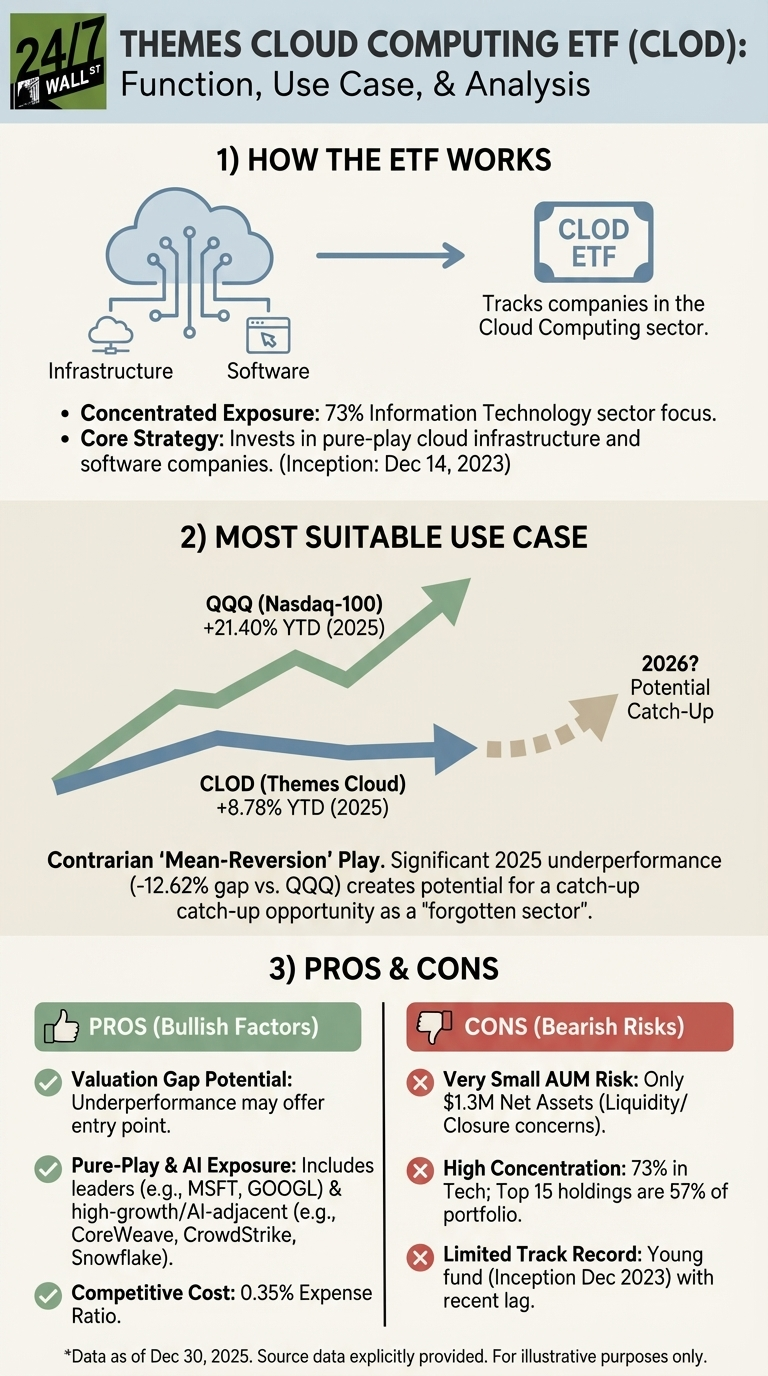
While investors chased artificial intelligence stocks through 2025, cloud computing quietly slipped into the background. The Themes Cloud Computing ETF (NYSEARCA:CLOD) gained just 7% in 2025, trailing the Nasdaq-100's 21% return by more than 12 percentage points. This underperformance might set up cloud computing for a strong 2026. CLOD launched in December 2023 with 73%... Themes Cloud Computing ETF Could Quietly Become One Of 2026's Best Investments | CLOD.

Wall Street kicks off May on a strong note due to strong jobs data and trade optimism. Tech leads the charge.

In its latest report released last December, the Bureau of Economic Analysis (BEA) estimates that the digital economy now represents 10% of the total U.S. GDP, or $2.6 trillion. The digital economy is also growing at an average annual growth rate of 7.1%.